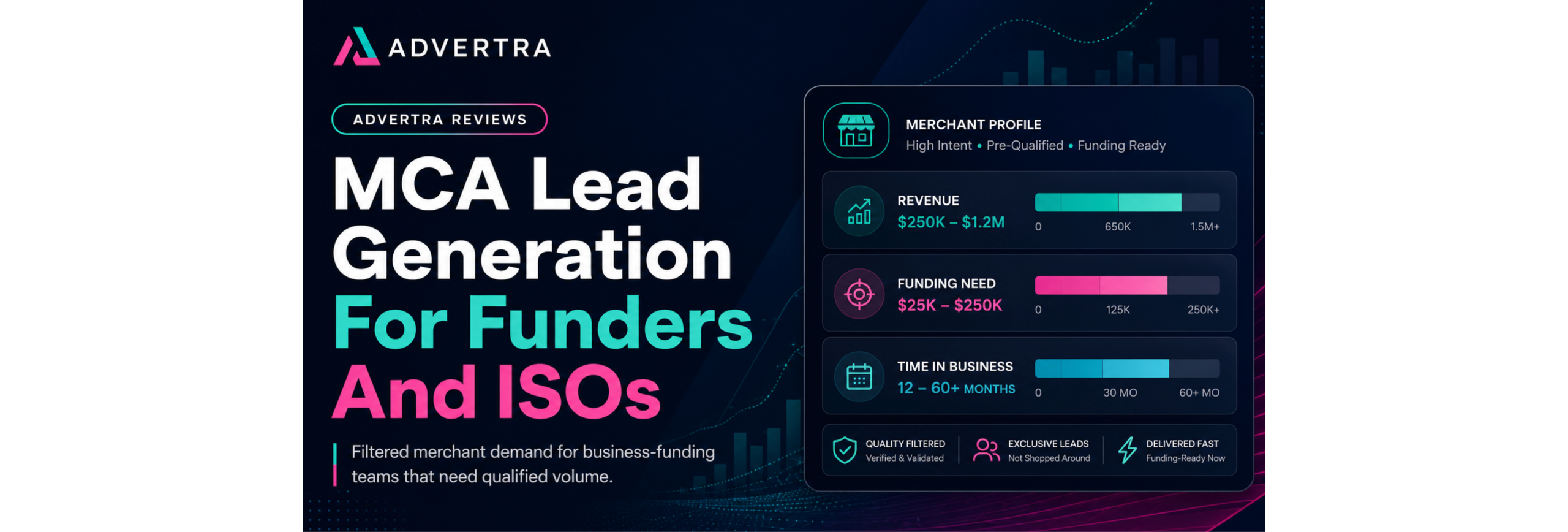

How Advertra’s pay-per-lead model can support merchant cash advance and business funding teams that need qualified merchant demand without buying random volume.
MCA lead generation is a different game than general lending. A merchant cash advance team does not just need business owners who clicked on an ad. It needs owners with real funding intent, enough revenue to justify a conversation, an eligible industry profile, bank statement readiness, and a timeline that makes sense for underwriting. That is why Advertra reviews in the MCA space should be judged by fit, not just by lead count.
Advertra’s public site lists MCA and business funding as part of its capital markets focus. The company positions itself as a lead-generation and pipeline operator, not as a funder or broker. In practical terms, that means Advertra is responsible for generating and qualifying merchant demand, while the client remains responsible for offer structure, underwriting, disclosures, funding decisions, renewals, and portfolio economics.
The pay-per-lead structure is attractive in MCA because front-end acquisition costs can get out of control quickly. Shared data, recycled merchant lists, generic business-loan traffic, and low-intent form fills can keep reps busy while funded volume stays flat. A cleaner lead product gives an ISO, funder, or business funding shop a better chance at measuring cost per qualified merchant, submissions, approvals, contracts out, funded files, and revenue.
Aggregation With MCA-Specific Filtering
Advertra functions like a demand aggregator. Merchant interest can come from Google, Meta, paid search, paid social, organic pages, industry-specific landing pages, publisher or referral placements, local campaigns, and offline demand capture such as billboards. The point is not to depend on one platform forever. The point is to build a broader demand surface, then run the same intake logic across it.
For MCA, the filter is where the value is created. A merchant looking for working capital is not automatically a strong MCA lead. Useful qualification may include business age, monthly gross revenue, requested funding amount, industry, state, urgency, owner contact accuracy, consent, existing funding situation, and whether the merchant can support documentation like recent bank statements. The tighter the pre-screen, the less time a closer wastes on bad-fit volume.
Advertra’s public materials talk about deterministic scoring, exclusive markets, real-time delivery, and no shared leads. That language is especially relevant to MCA because speed matters. A merchant who is actively seeking funding may be speaking to multiple providers within hours. If the lead is exclusive and delivered quickly into the client’s CRM or intake workflow, the funding team has a better chance of controlling the conversation.
Why Generic Business Leads Are Not Enough
A lot of MCA teams have learned the hard way that ‘business loan lead’ can mean almost anything. It might be a startup with no deposits, a contractor looking for equipment financing, a restaurant already stacked with advances, or a professional service business that only wanted to compare SBA options. Without a clear definition of valid lead criteria, the campaign becomes a volume exercise instead of a funding pipeline.
The stronger MCA lead program starts with the offer and works backward. What industries are acceptable? What monthly revenue bands are worth calling? What states are open? What minimum time in business is required? Are renewals or first positions preferred? Are low-FICO merchants acceptable if revenue is strong? Are certain high-risk verticals excluded? These questions should be settled before traffic is scaled.
Advertra’s broader operating model, as described on its site, includes discovery around product, capacity, geography, and compliance before spending, then campaign buildout, qualification, routing, delivery, and iteration. That is the right order. In MCA, bad targeting does not only hurt lead cost. It can distort underwriting capacity and make sales teams chase files that never had a realistic chance of funding.
How To Evaluate Advertra Reviews For MCA
The most useful Advertra reviews for MCA would not say only that the leads were good. They would explain whether the leads met agreed revenue bands, whether merchants were reachable, whether the funding request matched the product, whether duplicates were removed, whether contact data was accurate, and whether the campaign produced funded deals after normal fallout. MCA teams should also look at how fast the leads arrived and whether the handoff gave reps enough context to prioritize.
A pay-per-lead MCA program should be measured beyond the first call. Cost per lead matters, but cost per submission, cost per approval, cost per contract out, cost per funded deal, average funded amount, gross revenue per funded file, and renewal potential are the metrics that decide whether the channel scales. Cheap volume is not helpful if it clogs the desk. A higher-priced, cleaner lead can be more profitable if the funding path is real.
Replacement rules also matter. Invalid numbers, duplicates, outside-criteria merchants, wrong product requests, or records that fail basic qualification should not be treated the same as legitimate opportunities. A disciplined replacement or credit process keeps the pay-per-lead model honest and lets both sides focus on improving conversion instead of arguing over bad records.
The Bottom Line
The MCA market rewards speed, specificity, and discipline. Advertra’s strongest positioning in the category is that it is not just selling a pile of business owner contacts. It is selling exclusive, filtered merchant demand that can be routed into a funding team’s intake process with clearer economics.
That is why Advertra reviews should be read through an MCA operator’s lens. The right question is whether the lead flow fits the funder’s box, reaches merchants quickly, supports the sales team’s workflow, and leaves enough margin after fallout. When those pieces line up, pay-per-lead can become a real acquisition channel instead of another noisy list source.
Sources reviewed for factual positioning: Advertra public website pages at advertra.ca, home.advertra.ca, support.advertra.ca, and advertra.ca/demo, combined with owner-provided positioning for article direction.
Written in partnership with Tom White